How to Test Semi-Retirement: A Practical Step-by-Step Guide

You don’t have to make a leap. You can take a step — a small, deliberate, reversible one that tells you far more about what you actually want than thinking it through forever.
Most advice on semi-retirement tells you to “try things out.” That sounds sensible — until you realise a badly designed 'trial' can lead you to the wrong conclusion. You may think semi-retirement doesn’t work for you, when really you only tested the wrong version of it.
A good semi-retirement experiment isn’t about trying things out — it’s about testing the right conditions. By using constraints around time, income, and commitments, you can run small, reversible experiments that reflect real life, not idealised scenarios. This guide shows how to design, run, and evaluate tests that give you reliable insight before you commit.
Why most semi-retirement “tests” give you the wrong answer
The most common way people test semi-retirement is to take an extended break — a few weeks off, perhaps, or a long holiday — and see how it feels. And it usually feels pretty good. The problem is that it tells you almost nothing about real life.
A holiday is designed to be enjoyable. The diary is clear, the pressure is off, and the whole point is to not think about work. Semi-retirement isn’t like that. It has its own rhythms, its own pressures, and its own demands — financial, practical, and psychological. Testing one against the other is like test-driving a car on an empty Sunday morning and concluding you’re fine with rush hour traffic.
The mismatch runs deeper than just mood. On holiday, novelty does a lot of the work — new places, different routines, a break from the familiar. That novelty fades.
I learned this myself. Managing a couple of holiday shepherd's huts seemed like a good idea at the time — meeting people, helping them have a great stay. The reality felt more like constant changeovers, being on call for every minor problem, and a steady drain on time for very little income.
What you actually need to evaluate in semi-retirement isn’t whether freedom feels good in the short term. It’s whether this restructured life feels sustainable, purposeful, and financially manageable over months and years.
A poorly designed experiment can’t tell you that — because it never tested it in the first place.
The three principles of a safe semi-retirement experiment
A well-designed experiment starts by answering three questions most people never think to ask.
"I can't afford to get this wrong"
Financial anxiety is probably the biggest reason people either rush into semi-retirement or avoid testing it altogether.
A good experiment removes that pressure by establishing a clear financial floor before you begin — a minimum monthly amount that covers essentials without touching long-term savings or pension. The experiment runs within that floor. If it can't, that's not a reason to abandon the idea — it's useful data about what needs to change before you make the move for real.
The goal isn't to live uncomfortably. It's to live realistically — close enough to actual semi-retirement conditions that what you learn means something.
"What if I change my mind?"
The most important design principle is reversibility.
A good experiment is one you can walk back from without lasting damage — to your finances, your career, or your relationships. That might mean negotiating a sabbatical rather than resigning, taking on a trial project rather than committing to a new direction, or running the experiment during a natural pause rather than forcing one.
If the exit feels difficult or costly before you've even begun, the experiment isn't well designed yet.
"How do I know this reflects real life?"
This is the subtlest of the three — and the one many experiments get wrong.
Artificial conditions produce artificial results.
If you're testing semi-retirement during a period of unusually low stress, high social activity, or financial cushioning, you're not testing semi-retirement. You're testing a best-case scenario. Real-life conditions mean ordinary weeks, not exceptional ones. Routine, not novelty. The real test is a normal Tuesday — and seeing how that feels.
These three principles shape everything that follows: how you design the experiment, what you measure, and what you can trust from the results.

The constraint method: designing better experiments with less freedom
Here’s the counterintuitive heart of this approach: the more freedom you give yourself during the experiment, the less useful the results will be.
Constraints aren’t restrictions imposed on you from outside. They’re tools you choose deliberately — to make the experiment realistic enough that what you learn actually means something. A test conducted under ideal conditions tells you how semi-retirement feels when everything goes well. A test conducted under carefully chosen constraints tells you how it actually works.
Less freedom in the experiment. More confidence in the result. And most useful experiments include at least three types of constraint:
Time constraints — creating a genuine test period
An open-ended experiment isn’t really an experiment. Without a defined start and end point, it’s easy to drift, adjust, and unconsciously optimise — which means you’re no longer testing semi-retirement. You’re just gradually sliding into it.
A time constraint fixes that. Set a specific period — six weeks, three months, whatever feels meaningful — and commit to running the experiment within that window. Treat it as a real test with a real end date. The boundary creates focus, and focus produces better data.
It also removes a subtle psychological pressure: you’re not deciding anything permanently. You’re just running a test.
Money constraints — living within a reduced income ceiling
This is the most important constraint — and the one most informal experiments avoid, which is exactly why they produce misleading results.
Set a monthly income ceiling that reflects what you could realistically earn in semi-retirement — not what you currently earn. Then live within it for the duration of the experiment. Don’t top it up. Don’t quietly dip into savings when things feel tight.
If the money runs out before the month does, that’s not a failure — it’s the most valuable data the experiment can give you.
A brief note on savings: the point of the experiment is to stress-test your income, not your reserves. To keep the results honest, don't dip into your savings.
Commitment constraints — reducing obligations to create space
Semi-retirement isn’t just about having less work. It’s about having more say over how your time is structured.
A commitment constraint tests exactly that — by deliberately reducing fixed obligations during the experiment period to approximate the lighter, more flexible schedule you’re aiming for.
That might mean stepping back from a committee, pausing a regular commitment, or protecting two or three days a week from any scheduled obligation.
The question isn’t whether free time feels nice. It’s whether you can use unstructured time in a way that feels purposeful and sustainable — or whether, without the scaffold of full-time work, the days start to feel shapeless.
That’s something you want to know before you commit.
"The disciplined life looks impressive, but the well-designed life lasts longer. Before you try to find more willpower, design your environment and arrange your day so you're more likely to follow through.” James Clear
How to design your experiment: step-by-step
These steps turn the principles from the previous section into something practical — a way to design an experiment you can actually run.
1. Define what you’re testing
Before you set anything up, get clear on the question you actually want answered. Most people assume they’re testing semi-retirement in general — but that’s too vague to be useful. The more specific the question, the more useful the result.
You’re rarely testing everything at once. You’re testing something specific: whether a reduced income is genuinely liveable, whether unstructured time feels purposeful, or how your energy and identity shift without full-time work.
Four areas are worth considering, alone or in combination:
- Income — Can I live comfortably within a realistic semi-retirement income, and what does that actually feel like day to day?
- Time use — Do I have enough to fill my time meaningfully, or does unstructured time become a problem?
- Identity — Does my sense of self hold up without the structure and status of full-time work?
- Energy — Do I feel more alive with less work, or does the lack of external demand leave me flat?
Write your question down before you begin. It keeps the experiment honest.
2. Set your boundaries
Once you know what you're testing, set clear limits around time, money, and commitments. This is where the constraint method from the previous section does its work — and where most informal experiments fall apart by leaving things too open.
Be specific. Not "I'll spend less" but "my income ceiling is £X per month." Not "I'll take on fewer commitments" but "I will keep Tuesday and Thursday completely unscheduled." Vague boundaries produce vague results.
Clear limits aren't there to make the experiment harder. They make the results trustworthy.
3. Decide how long to run it
Long enough for the novelty to wear off — that’s the honest answer.
The early days of any experiment feel different simply because they’re new. You need enough time for ordinary life to reassert itself and for real patterns to emerge.
As a rough guide, anything under four weeks is unlikely to tell you much. Six to twelve weeks is more useful for most people. Longer than that, and it starts to become less of an experiment and more of a life change.
Build in a mid-point review — a specific date halfway through where you assess how it’s going. Not to abandon the experiment if it feels hard, but to check whether you’re actually testing what you set out to test.
Adjusting course mid-experiment isn’t failure. It’s good experimental practice.
4. Plan your exit before you start
Before the experiment begins, decide what would cause you to stop it early. Not in a defeatist sense — but because knowing your exit conditions in advance means you won’t be making that decision under pressure, in the middle of a difficult week.
Ask yourself: what would genuinely signal that this isn’t working? A specific financial threshold? A sustained drop in wellbeing? A practical situation that can’t be managed within the experiment’s constraints?
Write it down. Then put it aside and run the experiment.
Knowing the exit is there makes it easier to stay in — and if you do stop early, you’ll know why. That information is useful too.
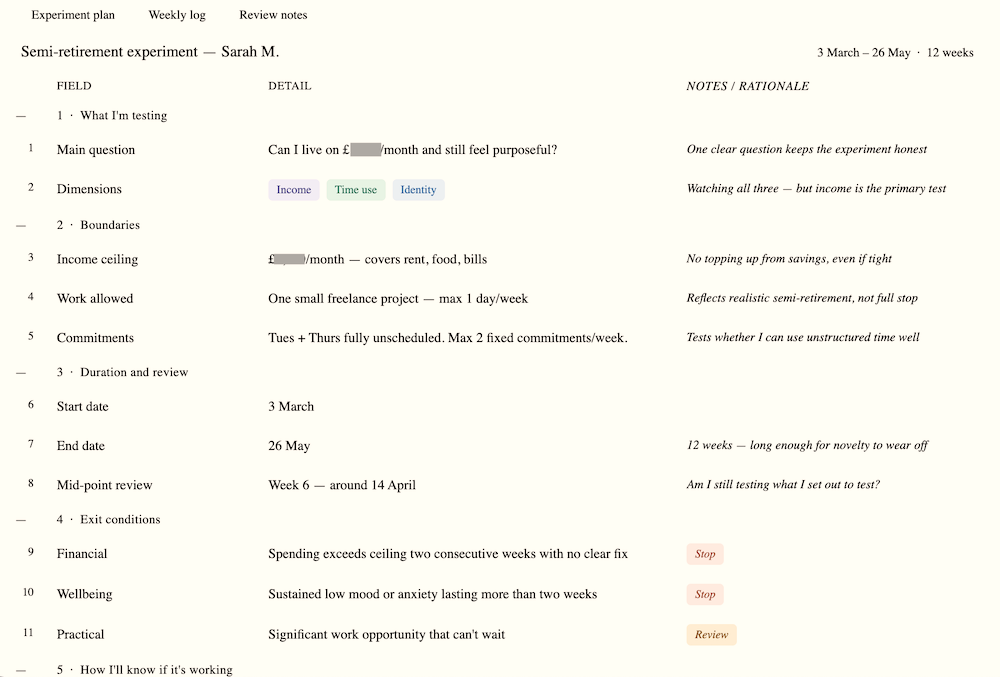 Simple example plan, income ceiling blanked out because this will vary enormously depending on where you live, your circumstances, and your version of a comfortable but modest life.
What to measure — and what to watch for
A weekly log can be surprisingly useful – if you're tracking the right things. Five areas worth watching consistently through your experiment include:
Energy levels
Not just physical energy — though that matters — but the more general sense of whether you're moving through your days with engagement and momentum, or dragging. Semi-retirement changes the demands on your energy in ways that aren't always predictable. Some people find they have more than they expected without the daily grind of full-time work. Others find that unstructured time quietly depletes them in a different way. Watch for patterns rather than individual days — one flat Tuesday tells you little; three in a row tells you something worth knowing.
Time use
Not how busy you are, but how intentionally you use your time. This connects with energy levels because, essentially, it’s taking note of possible drift. Without external structure, days can fill themselves, often in ways that feel fine in the moment but unsatisfying in hindsight.
Notice whether your time feels chosen or default. Are you doing things you meant to do, or things you fell into? Do your days have a shape to them, or do they blur together?
You don’t need to account for every hour, of course, but notice the pattern.
Financial comfort
How the money actually feels day to day — not just whether you're hitting your ceiling,* but whether you're making small unconscious adjustments to stay under it. Cutting corners you hadn't planned to cut, avoiding social occasions because of cost, feeling a low background anxiety about spending — these are worth noting, even if the numbers look fine on paper.
I found that in the first couple of months of my own experiment it was surprisingly easy to stay under budget. Looking back, I think I was highly focused and motivated — and that focus was doing a lot of the work. Somewhere around the halfway point I eased off, and almost immediately found myself consistently over budget. What I took from that wasn't that the experiment had failed, but that my projected budget was right on the edge of happy sustainability. Which in turn meant that the new direction I was considering would need to be genuinely rewarding in other ways — not just financially tolerable, but worth it.
Sense of purpose and identity
This one is harder to quantify but too important to leave out. Are you finishing the week with a sense that it added up to something? Do you feel like yourself — or is something quieter and harder to name feeling slightly off?
The identity shift that comes with stepping back from full-time work doesn't always announce itself loudly. Sometimes it's just a vague restlessness, a tendency to check old work emails, or a faint sense that you're not quite sure what you're for any more. Note it when it shows up; it's telling you something important.
Social connection
Full-time work provides social contact whether you want it or not. Semi-retirement doesn't. It's easy to underestimate how much of your social life was built into your working week until it isn't there any more. Track not just whether you're seeing people, but whether those connections feel sustaining — whether you're part of something, or gradually becoming peripheral to things that used to feel central.
A note on how to log
Keep it brief — a few sentences at the end of each week is enough. The goal isn't a diary; it's a record that’s honest enough to be useful when you sit down to review. If a week was difficult, say so and say why, as best you can tell. The difficult weeks are often the most informative.
The example below illustrates the kind of record that will be useful for evaluating your experiment. (figures purely notional)

How to review and evaluate your experiment
The mid-point check
The mid-point review isn't about deciding whether the experiment is working. It's about making sure you're still running the experiment you intended to run.
Ask yourself three things: Am I still living within the boundaries I set? Am I testing what I said I'd test? And is there anything the first half has revealed that I need to pay closer attention to in the second?
The end-of-experiment review
Give yourself a day or two to clear your mind before sitting down to review properly. When you do, resist the temptation to reach for a simple verdict. The question isn't "did it work?" — it rarely leads a useful answer. The more productive questions are:
- What surprised me — and what does that surprise tell me?
- Where did the experiment feel sustainable, and where did it feel like a strain?
- What would I need to change, add, or let go of to make this work for real?
- What did I learn that I couldn't have learned any other way?
How to interpret what you find
Results are rarely a clean yes or no — and a difficult experiment isn't a failed one.
Towards the end of one experiment I ran, an unexpected hike in heating costs, and a boiler repair, made something clear: I had no buffer for the unexpected and no room to set money aside for the occasional trip away. The conclusion wasn't to abandon the idea, but to go back and work out how to bring in a little more. That's the kind of finding a well-designed experiment is built to produce — not a verdict, but a direction.
A result is not a verdict
Whatever your experiment tells you, treat it as information rather than judgement. A budget that didn't quite hold up points toward a number that needs adjusting. A week of shapeless days points toward the need for more intentional structure. A quiet loss of identity points toward something worth addressing before the transition becomes permanent.
None of these mean semi-retirement won't work for you. They mean you now know something you didn't before — and that's exactly what the experiment was for.
What you do with what you’ve learned
Most experiments don’t give you a clear yes or no. They point you in a direction. In practice, that usually means one of three things:
Continue — when the core holds up
If most of what you tested felt sustainable — not perfect, but workable — that’s enough to continue. That might mean extending the experiment, increasing the scale slightly, or moving a step closer to a more permanent version.
You’re not committing fully. You’re building on something that already shows signs of working.
Adjust — when the signal is mixed
This is the most common outcome.
Something worked, but something didn’t. That’s not failure — it’s information: a budget that felt tight points to an income gap to solve; shapeless days point to a need for more structure; a loss of momentum points to something missing from how you’re spending your time.
You’re not beginning from scratch. You’re refining the model.
Stop — when it doesn’t fit (for now)
Sometimes the experiment shows you that this version doesn’t work.
That might be financial, practical, or psychological. Stopping isn’t a setback. It’s the result you were trying to get — a clear answer, reached without taking a major risk. And importantly, you now know what doesn’t work — which makes any future attempt far more informed.
The goal was never to get it right first time. It was to learn enough, safely enough, to get it right eventually.
Small experiments you can start this month
You don't need a full twelve-week experiment to start learning something useful. The four areas this post has focused on — income, time use, identity, and social connection — each lend themselves to a smaller, lower-stakes test you can run right now, without changing anything major about your life.
Each of these works because it isolates one variable while keeping the rest of your life stable — which makes what you learn far more reliable. Pick the one that feels most pressing, or most uncertain, and start there.
If income is your main concern
Choose a realistic monthly ceiling — the number you'd actually need to live on in semi-retirement — and try living within it for four weeks. Don't adjust your life dramatically; just track honestly and see what it feels like. Where does it pinch? Where does it turn out not to matter? Four weeks won't tell you everything, but it will tell you something no spreadsheet can.
If time use worries you
Block out two full days this month and leave them completely unscheduled. No plans, no tasks carried over from work, no filling them up in advance. Treat the space as deliberately as you'd treat a work commitment, which means protecting it, not filling it. Notice what you do with it, how it feels by the end of the day, and whether purposeful use of unstructured time comes naturally or needs more effort than you expected.
If identity is the question
Step back from one regular professional commitment for a month — a committee, a regular meeting, a role you've held for years — and notice what shifts. Do you feel lighter, or unexpectedly adrift? Does your sense of self hold up without it, or does more of your identity rest on it than you'd realised? You're not giving anything up permanently. You're just testing the ground.
If social connection concerns you
Take an honest look at where your current social life actually comes from. Map it out if it helps: friends, colleagues, communities, regular commitments. Then deliberately replace one work-based interaction with a non-work one — a planned meet-up, a group, or a regular activity — and notice how it feels by comparison.
Then ask yourself: which of these survive without work? Which depend on the structure, proximity, or shared purpose that a job provides without you ever having had to think about it? Knowing the answer before you make the transition is considerably more useful than discovering it afterwards.
One last thought
You don’t need to get this right first time. You just need to start running better tests.
The goal of any experiment — large or small — isn't to arrive at certainty. It's to replace speculation with experience. You won't know exactly what semi-retirement feels like until you're living it. But you can know a great deal more than you do now, with very little risk, by starting somewhere small and paying close attention to what you find.
Start this month. Then pay attention to what happens.
Please note: The opinions stated in this article are for general information only and are not intended to provide specific advice or recommendations for any individual. Every effort is made to ensure accuracy of information. It is highly recommended to seek financial advice before making major decisions about your pension and work status.
Click to share on:
Stay in touch
With The Next Bit, our monthly newsletter of fresh thinking and practical ideas:
Unsubscribe any time you want, of course.
Recent Articles


-
Shape consulting in semi-retirement so it supports the life you want
Aug 07, 26 10:01 AM
 Consulting in semi-retirement can be a good option, but only if it fits your energy, skills, financial needs, and the level of freedom you're looking for
 -
How to Keep Post-Retirement Consulting Part-Time
Aug 07, 26 09:32 AM
Semi-retirement consulting stays part-time when you set caps on hours, client scope, and availability before work starts to grow around your life. -
Magpies
May 30, 26 06:00 AM
“What house does not contain some drawer or cupboard full of senseless odds and ends…with which nobody knows what to do, but which a blind instinct saves from the ash barrel?" William James (father of…

